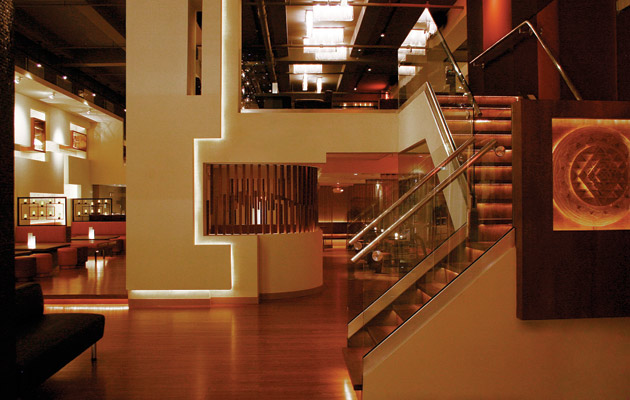
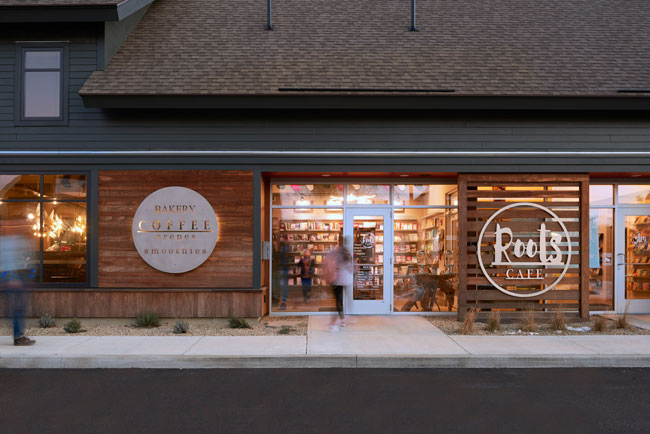
Whether a high-end establishment or fast-casual eatery, restaurant design trends are centered around having a brand voice and identity, then homing in on it.
“These can run the gamut with the overall look and aesthetic, from a heritage or cultural representation to relaying what the food represents,” says Liz Neuffer, project designer, Aria Group, Oak Park, Ill. “Clients are finding a design voice to determine what makes them stand out and zeroing in on that.”
In the fast-casual space, designs are typically logo driven and combined with other branded elements. With higher-end restaurants, it’s more about incorporating a classic, timeless look, Neuffer notes. In both cases, staying authentic and consistent to the brand and message helps establish the vibe and speaks to the overall customer experience.
Color Schemes and Materials
Color schemes are also typically dependent on brand identity. For this reason, “we’re not seeing any particular color trends in restaurants,” Neuffer says. “Gone are the days where a steakhouse has a red color scheme or a seafood restaurant is predominantly blue. More operators are leaning into brighter natural finishes and colors, so there is a balance that is more inclusive for universal appeal.”
Materials are more natural, such as wood, and likely to have a sustainability component. There is a concentration on the details, including custom millwork. “Additional hardware is more thoughtful, and textures are important, such as stone with a chiseled look, rattan or wicker” for added dimension, Neuffer says.
Lighting
With lighting, LED is prominent, and with today’s technology, shapes, sizes and formats are practically limitless.
LED fixture sizes are shrinking due to microelectronics. Track heads are smaller as well. There are also more fixtures available that create different glows, including edge and shelving lighting. This allows designers to create custom light features.
There has been a significant uptick in acoustical lighting like baffles and wall panel systems in high-end foodservice operations. These include integrated lighting and sell as one unit or a total package.
In addition to Wi-Fi controls, smartphone controls have become more prevalent.
“We’re seeing more pottery-based light fixtures, but these don’t work for all clients,” Neuffer notes. “Higher-end restaurants are seeking glitzy fixtures, so crystal, glass and brass lighting are still prominent. Plus, a lot more vintage, repurposed and reclaimed lighting is being used to set designs apart.”
Walls and Floors
Because walls are a canvas that drive home brand messaging, wall covering customization is one of the biggest trends in foodservice. This allows operators to incorporate specific branding, graphics or signage into a space. Big and bold designs are in, and walls that blend into the background have become less popular. Foodservice operators want to incorporate art for their walls with eye-catching colors and beguiling designs.
“Today, the larger the pattern, the better,” Neuffer says. Concrete looks are trending, especially in urban operations and spaces with an industrial aesthetic. Even leather looks are a possibility, and hybrids with simulated wood or concrete are often used as a background for logos.
With flooring, luxury vinyl plank (LVP) has come a long way from a durability standpoint as well as from a selection standpoint, now offering more patterns to compete with traditional tile. It’s now more realistic for these products to evoke the look of natural materials such as wood grains, stone and tile. “We’re still seeing tile, hardwood and carpet chosen more often in foodservice,” Neuffer says. “However, LVP continues to gain popularity and is budget-friendly.”
She adds that cement tile popularity is also on the rise due to the bevy of shapes available, such as hexagons and triangles, as well as expanded color options.
Acoustics
Acoustics is a key factor to creating a restaurant’s ambience. Noisy restaurants are also a top complaint of diners. “For this reason, more operators are thinking about acoustics than ever before,” Neuffer says. “Our clients don’t like the typical acoustic ceiling tile, so it’s key to incorporate acoustic products that blend in.” She says that the best products are ceiling applied but adds that incorporating more upholstery and drapery, along with fixed seating and wood, mitigates some noise.
Fiberglass panels are popular and customizable. Panels can also be filled with material like denim or cotton. For those not wanting to hang panels, dense drapery in six to eight layers provides the same effect as 2 inches of foam. PET felt is decorative, is available in multiple colors and shapes, and can be used in a wide variety of acoustical applications.
Exposed ceilings with an industrial appearance are on trend but more difficult to deal with acoustically. In this case, vertical baffles provide better sound control.
Restaurant Components
“The bar is typically a restaurant’s anchor, so it’s important to make it a jewel box,” Neuffer says. “We’re incorporating lit-up alcohol bottles since lighting and materiality prevail.”
In addition, more operators are incorporating new equipment technology behind the bar, including wine preservation systems, automated beer systems that fill glasses from the bottom, turbo or fast flow taps, and table taps.
Restaurants are increasingly incorporating more single-use stalls in restroom spaces. As an alternative to stall designs that can have gaps between doors and pilasters, there are restroom partitions that not only provide more refined styling but also enhance privacy. These are constructed of phenolics, enameled tempered glass, recycled plastic or stainless steel. Designs that incorporate the European stall model that forms a perimeter around communal washing stations with open circulation have also become more popular. These gender-neutral layouts help facilitate one-way traffic and minimize cross-traffic.
The Outdoors
Since the COVID-19 pandemic, outdoor seating has been a big focus in commercial foodservice. “It is more prominent, yet designs are either minimalistic or loungy and residential-looking,” Neuffer says. “Operators want the outdoors to be an extension of the interior with a similar design.” Extensive greenery has been an ongoing trend, along with square tabletops for added versatility, she adds.
Exterior cladding is hot as it’s easy to update, helps signify a new brand and is simple to add to an existing facade. “It can be metal, wood or EIFS [an Exterior Insulation and Finish System that combines insulation, a weather-resistant barrier and a decorative finish], which is not new or common but has become popular for those seeking exterior customization,” Neuffer says.
There also are new sustainable cladding options that use recycled plastic, leftover sawdust and other materials that would normally be thrown away. Panels created out of various recycled materials are durable to withstand harsh weather and can be customized.
“With social media, everyone is inundated with trends and designs, and it’s hard to keep up,” Neuffer says. “Decor should last 5 to 10 years, so it’s important to note this when looking at trends.”