 Jill VenturaA culinary-trained former restaurant operator with 30 years of experience in the restaurant and hospitality industry, Jill Ventura has served on project teams and been a development leader for firms including Corner Bakery Cafe, Le Duff America and Wasserstrom. She now leads the U.S. business development team as vice president of strategic growth for design firm Harrison.
What events and experiences have shaped your career?
JV: I had an unconventional approach. I received a degree in hotel/restaurant management and then went to culinary school. I had worked my way through college and was cooking in an Italian kitchen. I discovered how much I loved cooking on a line and all the learnings and everything that you can acquire from that. I was a sous chef with the Four Seasons for quite a few years, learning execution and production of high-quality food. Four Seasons is known for their extreme, over-the-top attention to detail.
I then worked at Corner Bakery Cafe and opened many restaurants for them. I started on the culinary team and eventually ended up on the development team, working on processes from lease negotiations to procurement because I understood what it took to operate a restaurant. Brinker International owned Corner Bakery for a while, and their architectural and kitchen design team brought me in for almost six months to work intensely with them. We opened about 60 restaurants. I became like a sponge. I understood how kitchen operations worked and where all the equipment went and the design, but I had never really gotten into the drawings. Working side by side with the architects and kitchen designers was a huge opportunity to absorb as much information as I could. I learned to read architectural drawings and understand specifications. It was the foundation for what I am doing now.
What are some current trends that impact both design and operations?
JV: The guest is looking for an experience when they dine. It’s not just going out to get food, especially if they’re dining in the evening. I think it’s really due to the cost of food and labor. Whether it’s a QSR, fast casual or fine dining, people are spending more now than they ever have. They know they want good seating, great food served in a timely fashion — and they want good service. In the past, you could walk into a hole-in-the-wall and have a great meal and be satisfied, but that’s not necessarily the case now. People have higher expectations because of the cost. So now, it’s “How can we elevate the restaurant interior or the experience for the guest? How do we do that cost-effectively and be creative to develop that atmosphere where the guest is going to return regularly?”
We don’t necessarily want to create one Instagram moment, but we want to create moments throughout the whole restaurant because that is what creates intrigue and the desire to return. It’s like little gems hidden throughout to route the customer through the pathway of the restaurant. You have to figure out what’s important to the client — what they want the guest to walk away with — because you are developing a relationship. If the guest has an experience that was purely delightful from the food to the service to the atmosphere, they will be your brand ambassadors.
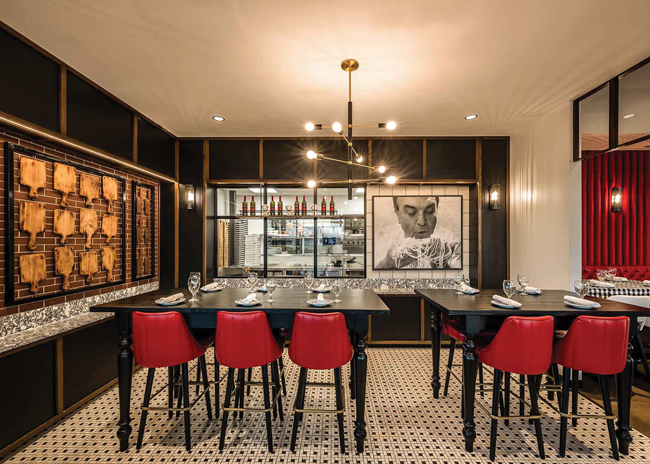 With a large photo of a chef handling pasta and cutting boards displayed on a wall, Harrison’s design at the Sicilian Butcher in Dallas creates a memorable environment. Image by Matthew Glac, MG Fotografix LLC
How do you do that?
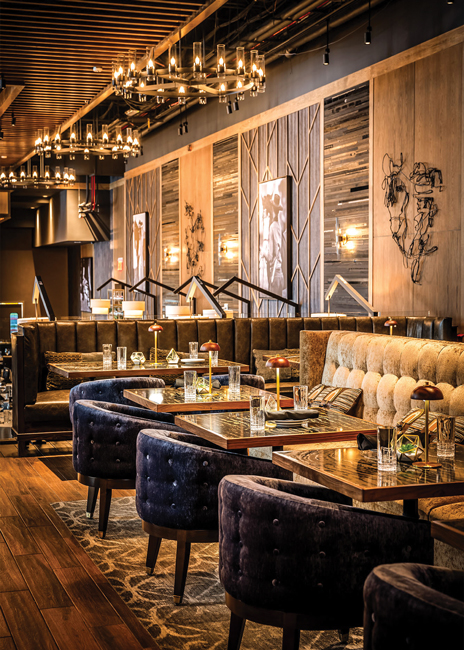 High-end lighting elements set a distinctive mood at Fogo De Chao at the World Trade Center in New York. Image courtesy of Harrison.JV: It could be the material on the bench that you’re sitting on. It could have a luxurious feel, or it has that look that indicates sitting on it will be comfortable. Or it could be your tabletops — whether you are using linen or a hard surface. Even in QSR, there are amazing laminates. There is such a vast number of materials out there with different textures and feel to them. Lighting is super key whether you are QSR, full service or premium dining. It impacts how your food looks. I’ve been to many beautiful restaurants and they’re so dark over the table that you can’t even see the menu. To brighten things a bit, there are many unique touchpoint lights that you can put on the table, or you can install a spotlight. Bathrooms can also create a lasting impression.
I’ve noticed recently, especially in the QSR space, that there’s a sameness to interior design. Many are very bright, with a lot of whites and grays. Have you noticed that?
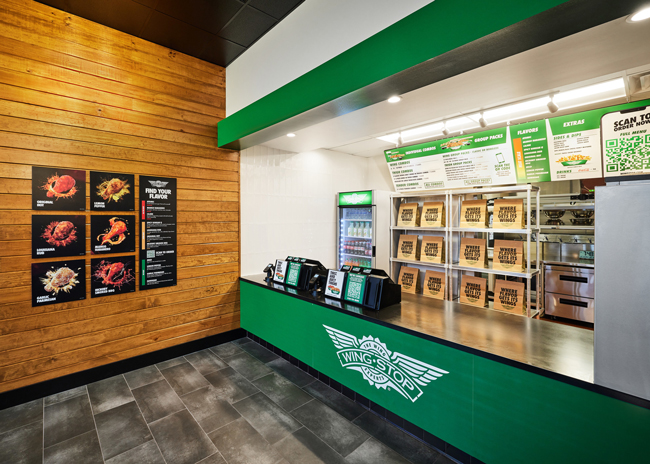
JV: We have coined the term at our office: the sea of sameness. No matter what type of restaurant, you still must create a memorable experience. It can be as simple as a variety of chairs. Or it’s different colors of tabletops so when people walk in, they don’t feel like they are in a sterile hospital environment. Brands must be authentic to who they are and what they’re telling the guest. Even if the customer is only there for 20 minutes, you can create an experience with art, decor, lighting and furniture. If it’s a plain, stark white, you’re maybe not going to have the PPA [per-person spending average] that you want.
What’s it like talking with clients about “the sea of sameness” in the context of design planning?
JV: Many brands have a prototype, and if you are doing prototype work for them, you have to follow their aesthetic. There are always challenges if you are working with a brand that has the same elements, but when we are working with clients like that, we also like to push it a little bit. How can we use those elements differently to make them stand out or make the design more influential for the brand — how to make it more recognizable? If they have brand pillars so that they understand who they are and what they are trying to do, that’s very key. If you don’t have those design pillars, sometimes brands flounder a little bit. They may float around in different styles and aesthetics, and it’s like they can’t latch onto one. Guests are very savvy now, and they understand if a restaurant has nailed it. Customers recognize if the menu board is not placed correctly, or if they can’t easily find the drink station, or if the wayfinding is poor. Those things must be in alignment for the restaurant to properly execute from the guest’s viewpoint.