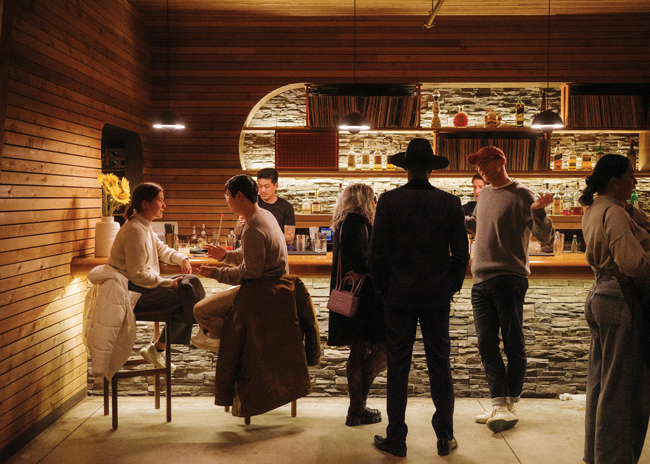
When husband-and-wife team Jon Sybert and Jill Tyler closed Tail Up Goat in Washington DC in December of 2025, fans of the 10-year-old Michelin-starred restaurant were glad to learn they had plans to open a new concept in the same space. Diners knew they could expect the same level of food and hospitality, even if an entirely different service model was in the works. “Post 2020, our restaurant never worked again,” says Tyler. “Between inflation and rent and labor going up and us doubling down on benefits, there was just no way to make the numbers work.”
The couple (Sybert is the chef) was inspired by Birdie’s in Austin, Texas, to create a casual counter service restaurant with a level of hospitality that rivals the fine dining their regular guests had come to love. They worked with DC-based Edit at Streetsense to open Rye Bunny (named after the couple’s rescue dogs) in early April. “They had a working restaurant, and their goal was: How little can we do to make this work? But, at the same time, make it feel like it’s a different place that works differently than before,” says Brian Miller, Edit at Streetsense’s co-founder, principal, and senior designer who had worked on Tail Up Goat as well.
 The glass-enclosed menagerie has a bar, high-top tables, and windows that open to the street. Pendant lights hang from the gold trapeze bars above the bar. Image courtesy of Douglas Friedman
To make room for a waiting and ordering area, the bar had to go. “We wanted to make sure we had something where people could be inside, out of the sun, heat, rain, or cold, and also have a drink in their hand,” says Tyler. The waiting area was the first thing guests saw when they entered, and it needed to accommodate guests both in line to place their order and to wait for their table as needed. “I think what can make someone feel a little stressed out entering the space is one, if it feels like chaos, and two, if you don’t know what’s going on or what to anticipate,” says Tyler.
The homey, American folk-art inspired vibe throughout Rye Bunny helps, as does a waiting area that is separated from the dining room with a half wall. The half wall is dotted with wooden newel posts and shelves decorated with baskets and pottery on one side, and red, curvy wainscoting and a drink ledge on the other. Custom stained glass created by Capitol Hill Stained Glass Founder Hannah Bernhardt hangs from the shelves and mimics the design of the vintage quilts hanging throughout the space (one dates to the 1860s!), and colorful patchwork tiles on the floor. Once guests reach the counter, lit by welcoming lamps and drippy candles, they can take their time placing their order and then make their way to a table or grab a glass of wine or a batched cocktail (a necessity after removing the bar) and wait at the drink ledge. “Once you sit down, it’s full service,” says Tyler. “There’s a server getting water, keeping drinks flowing, setting clean plates and silverware, taking dessert orders and handling payment at the end. It’s a really interesting hybrid in that once you sit down, it feels really familiar.”
To maintain the homey vibe throughout, Miller’s team swapped out the strip ceiling lighting for dimmable paper globe lights dotted with pressed wildflowers, string lights and candles on the tables. Colorful leather rag rugs are draped over wooden banquettes and paired with mismatched folksy chairs. “Everything feels like how you might set up a great dinner party,” says Miller, who also flipped two existing banquettes in the front window from facing each other to facing the dining room. “I think some counter service restaurants are pretty stripped down, which makes sense. It’s kind of peeling back to a real, very basic mix of, ‘we’re going to serve great food and we’re not making it about the rest of that experience,’” says Miller. “We wanted to have a really comfortable, kind of homey, cozy dining room and an experience that felt really personal and intimate.”
From Folksy to Focused
With 74 locations around the country, Cooper’s Hawk also strives to keep things familiar in each of their wine-focused restaurants. “They really do want their restaurants to be a collection and not looked at as a chain, so they’re all very unique,” says Aria Group Senior Designer Stacey Bouwman, who’s worked on dozens of locations for the chain. Aria Group has served as lead designer and architect for the brand since 2006. The latest opened in February in Alpharetta, Ga., in a 10,878 square-foot space that maintains the same hospitality ethos of all of Cooper’s Hawks locations and also showcases details that speak to the chain’s Georgia debut.
 Custom bird wall coverings near the smaller booths in the dining room at Cooper’s Hawk in Alpharetta, Ga. Image courtesy of Kathryn McCrary“It was designed with a really strong connection to nature,” says Bouwman. The most obvious element is the 64-seat wrap-around patio (one of the biggest in the Cooper’s Hawk portfolio) that abuts a 160-seat dining room and adjusts to the local weather with roll-down shades, heaters and fans. Outside the building is a mural by local artist Nick Turbo Benson that depicts diners enjoying wine over dinner. Inside, touches include custom blue and beige bird motif wall coverings, antique mirrors behind the bar, woven chandeliers, and high-quality faux plants that add thoughtful color throughout.
Bouwman says the brand has evolved over the years, leaning less on dark millwork or overly luxe looks, and more on lighter, fresher vibes that work perfectly for the southern location. “They don’t want to be a restaurant that’s only for special occasions. They want people to go all the time,” says Bouwman. In true Cooper’s Hawk fashion, this location allows moments for every brand experience: a wine-tasting area with a long bar when guests enter, a private dining room for 48, a retail area with branded wines and glassware, and a green wall with the phrase “perfectly paired” on a neon sign for photo ops. The main dining room features half walls to help with table privacy and noise, along with a window into the open kitchen with green velvet u-booths for prime seating (something you will find at other locations). “It’s kind of that see-and-be-seen seating opportunity,” says Bouwman. “It was important to have a mix of different seating styles for different parties and experiences. They don’t want a big sea of tables, that would feel like a cafeteria.”
A mix of seating styles is just one reason the stunning JouJou fits right in with its design district neighbors in San Francisco. Jon de la Cruz of DLC-ID and Heidi Liebes of Liebes Architects worked with Lazy Bear owners David and Colleen Barzelay on their French concept that opened in a former cafe space in early March. “They knew what the intent and vibe was going to be and that was French Riviera, late ’70s, kind of sexy but also kind of traditional, but also timeless like if it were a restaurant that had been around for 100 years and got remodeled a couple times,” says de la Cruz. “So, there’s some bits and pieces that didn’t necessarily fit but also made sense.”
De la Cruz says they changed almost everything but the wooden floors, adding six connected rooms throughout the 6,500-square-foot space outfitted in Parisian-inspired shades of pinks and greens. “The thing in restaurant designs these days, especially in San Francisco, is you want the restaurant to always feel full even though you may not have maximum capacity. Being flexible with the rooms and having them be connected but also be able to close them off is important because that way if you are open for brunch and there’s not that many people, you can focus on seating one side and then you can open up to the next,” says de la Cruz. “And you could sell off those rooms to private parties and maximize your revenue.”
 The colorful American Folk art-inspired dining room at Rye Bunny. Image courtesy of Scott Suchman
Each area offers a hospitable experience for any size party. The Rose Room with its lacquered cane-back bistro chairs and rose-colored curtains is perfect for intimate dates, a small sunken wine cellar and private dining room can accommodate small gatherings, the raw bar area offers prime views of live oyster shucking and seafood towers, and wraparound booths in the dining room can accommodate bigger groups. But the main attraction might be the menagerie: a glass-enclosed patio that was the former restaurant’s outdoor space. “Logistically it was a challenge and financially it was a challenge because glass and steel are not cheap, so we wanted to make sure the design stood the test of time, and also that it functioned and didn’t turn into a green house,” says de la Cruz. The doors open for cross ventilation, heaters were installed for chilly nights, and brass trapeze bars keep the pendant lights perfectly centered over a 22-seat marble bar below. For the floors, de la Cruz was excited to replace concrete blocks and create a new pattern, taking a nod from bistros in Paris and Vienna for the purple and green encaustic tile pattern. “I always take pictures of floors I like and was able to create a fun pattern that really balanced out all of that glass and still make it elegant without over-flexing the design and making it feel too fancy.”
De la Cruz says feeling overly fancy can backfire these days, at least in San Francisco where he says diners have grown skeptical of the quality of the food if the design appears overdone. The key to building a beautiful dining room with the right balance of functionality and hospitality might just be leaning more into comfort. “It should feel like a place you go all the time but you don’t know the last time you were there,” says de la Cruz. “That familiar yet exciting feeling of déjà vu when you walk in and feel like you’ve seen it before.”