Indian food is finally starting to receive the recognition it deserves in the United States. Inauthetnic Indian food served in forgettable surroundings is being replaced by specialized regional cuisine in design-forward restaurants that showcase the best of Southeast Asia.
From New York City to Scottsdale, Ariz., we look at some outstanding designs.
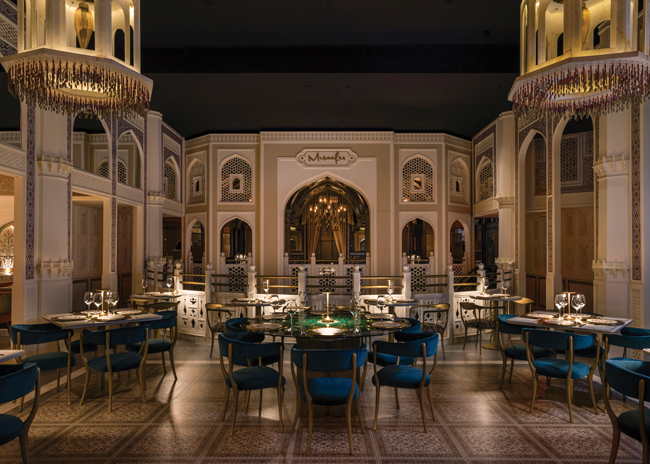 Glass windows, columns and inlay panels evoke Indian monuments inside Musaafer. Image courtesy of Julie Soefer
Musaafer
New York City
Musaafer was designed as an immersive experience.
“We really wanted diners to feel like they’ve come to India,” says Mitho Malik, CEO and managing partner. “We wanted to create a unique experience but also to show the art and architecture of India.”
This enormous, 10,000-square-foot restaurant is spread over a ground floor (main dining room and private dining room) and a basement (a bar and a chef’s tasting studio).
Guests enter to find a space with a circular gold and brass host stand. Animals are depicted around the edge to emulate an Indian hunting scene. The host stand is also inspired by the Banarasi sari, which features gold and silver threads.
The host stand’s exterior has three layers: The bottom is the lightest in color, the middle has a cutout of trees and shrubs, and the top layer is the animals “so it creates that 3D effect of watching the animals in a jungle,” Malik says. Above it is a circular chandelier that’s raw silver on the outside and embroidered with “Musaafer.” On the inside are miniature pictures of animals hunting.
This area is divided from the main dining room by a marble wall that features rows upon rows of windows with beautiful glass inside, inspired by a monument in Jaipur. “Architecturally, you don’t want to walk into a huge restaurant, especially early in the evening. And it makes sense for there to be a little bit of mystery with elements that pop out and are talking points,” Malik says.
Malik and her husband, Shammi, wanted the main dining room to be pristine, so they chose a base color of white, which echoes the Taj Mahal. To emphasize this, the dining room’s columns mimic the ancient monument’s facade. Because they were restricted in how high they could build — even with soaring ceilings — they created arches through the space.
To break up the vast room, there are different types of seating “to keep the element of interest,” Malik says. The goal was “to make it interesting and to make it a different experience but also to bring a certain element of coziness and homeyness.” Two alcoves around the sides sit under more arches. There’s a lot of energy in the center of the space, while the alcoves have a different feel for different occasions, she points out.
The private dining room features hand-painted panels similar to those in the Sheesh Mahal, a palace in Jaipur. The focal point of the room is a lotus chandelier with red, green and blue flowers. The lotus represents beauty, prosperity and fertility in Hinduism, and the chandelier brings a modern feel, says Malik.
She wanted the chandelier to look like a wild lotus pond. “The flowers are going in all kinds of directions and add to the drama,” she explains.
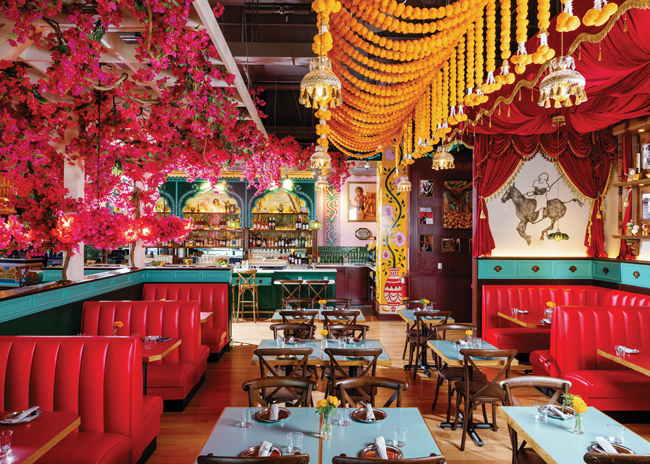 The color, texture and energy in Chai Pani drenches the senses and tells a story through murals. Image courtesy of Tim Robison
Chai Pani
Washington, D.C.
A riot of color, texture and over-the-top design awaits customers inside Chai Pani, which opened this past summer with a design philosophy of “more is more,” says Brand and Creative Director Michael Files.
“We wanted this restaurant to be an assault on the senses,” he says. “It’s very indicative of the Indian street food scene when all your senses are jamming.”
The 4,000-square-foot restaurant celebrates Indian street food through both its menu and design. The goal was to emulate the chaos and bustle of India’s streets. Files wanted to create a restaurant that was elevated yet “a bit chaotic,” he says.
The restaurant is broken up into sections with different decor. An area of red booths sits under swagged red material on the ceiling to emulate the Irani cafes found in India; another booth area is enclosed with faux bougainvillea with its trademark magenta flowers. Loose tables sit in between, under swags of faux marigold garlands in a vivid mango color. Files wanted to create distinct seating areas so guests could have different experiences on different occasions. Breaking up the space also makes it feel more cozy, he points out.
“We want people to feel enveloped in this space and surrounded by color and texture,” Files says. “India is huge on color, but you’ve got to tune into it right and have touchpoints.”
Chai Pani’s bar is based largely on the palaces of Rajasthan, featuring arches in the quintessential ornate Mughal scalloped style of Jaipur, with floral motifs influenced by the city as well. The bar back painting shows a woman serving toddy (palm wine) and also depicts Parsi people in the fields, representing the story of owner and chef Meherwan Irani, whose grandfather had a toddy shop.
Chai Pani features an elaborate host stand. It’s the first thing guests see and is a simple three-sided geometric shape that sits under a “mushroom cloud” of fake marigolds. It’s a wow moment, Files says. The host stand sits in a large lobby, which also features Chai Pani merchandise and a pani puri (deep-fried street food) cart. This, he says “becomes an activated street food area” where guests can wait for their table or enjoy a more casual dining experience.
To decorate the restaurant, Files brought in around 15 artists. Hand-painted art is emblematic of India, he says, and the artists also recreated Indian typography in signs. They painted on the walls, on columns and on the back bar, bringing more color and authenticity to the venue.
Chai Pani has the same feel outside, with a vibrantly painted upper mural highlighting Indian flowers and tigers (as you’d see on hand-painted rickshaws in India), more faux bougainvillea and brass globe pendants, reflecting the brass bells often used as decor in India. The inside of the restaurant glows through the windows. “You’re getting immersed in the restaurant from the outside,” says Files.
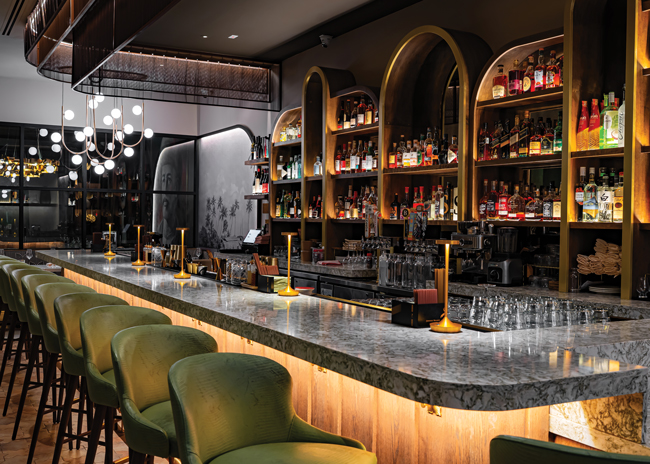 Arches throughout Indibar create continuity while the colors encompass Arizona and the Indian jungle. Image courtesy of Indibar
Indibar
Scottsdale, Ariz.
The design goal with Indibar was to create a transportive place with very modern and subtle design.
A repeating element throughout the 3,000-square-foot restaurant is arches. Multiple arches make up the back bar, enclosing shelves for bottles and backed by smoke mirrors, which creates “both drama and depth … allowing light to bounce through the space while showcasing the vivid, colorful nature of the liquor bottles,” says Megan Cords, director of design, Hale Collective, Phoenix, Ariz.
Above the bar, the soffit also has embedded arches, “reinforcing the rhythm and continuity throughout the design,” says Christina Grey, project lead, Hale Collective. “We used bronze metal mesh to evoke the intricate patterns of Indian jewelry, adding texture and a subtle sense of opulence to the space,” she adds. “Lighting was integrated in layers to give depth and presence to the framework.”
“We thought about what symbolizes Indian architecture, and it’s a lot of arches,” says Jonathan Rodrigues, managing partner and bar creative director. “We decided to just use a simple curved arch, and that is what unifies the space — it’s Indian but it’s so modern and simple.”
“We wanted the design to create a backdrop for the cuisine,” says Cords. “It is vibrant and rich and emulates the flavors on the menu. We don’t want it to overpower the food.”
The design team selected the colors in Indibar to reflect both the orange of Arizona sandstone and the deep green of the Indian jungle. “We chose the colors to celebrate the dialogue between two landscapes,” says Grey. “The palette creates a space that feels both vibrant and grounded, bridging these two distinct worlds.”
The restrooms are not a forgotten element at Indibar. Hale Collective sourced tropical wallpapers with cheetah and leopard motifs, which pop up throughout the space, appearing on menus, throw pillows and other subtle details, “keeping the design cohesive and sophisticated,” explains Cords.
Display cubicles at the entrance and by the washrooms feature vintage items from India that tie into various elements of the restaurant, such as a mortar and pestle that’s more than 100 years old. “This is a nod to the unity among diversity that defines India. It has everything from Hindu temple door handles, Islamic keys and Sikh karas [steel or iron bracelets],” says Rodrigues.
“We designed a backdrop with indirect and spot lighting to showcase the cubicles throughout the space, creating moments that celebrate each artifact’s craftsmanship and story,” adds Grey.
A private dining room features a mural in warm, earthy tones with two female empowerment figures as well as a modern Indian woman in the center with wavy hair to symbolize Lehr, the name of the room, which translates to “wave,” according to Grey.
The chandeliers in this room are also wavy “while the dining room chandeliers were selected to echo the repeated arch motif, reinforcing the architectural rhythm throughout the space,” Grey says.
Diners can see into the semi-open kitchen through a window, 8 feet wide by 3 feet tall. “We wanted people to have a full, intimate, elevated dining experience while seeing how the food is prepared, without all the noise,” says Nigel Lobo, chef and partner.